

My Complicated Relationship with Poetry
Sometimes it’s our art that finds us, not the other way around

I distinctly remember my seventh grade teacher Mrs Ford catching me talking in class (again) and declaring, for all the room to hear, “What a waste of a talent.” I’m sure she would be pleased to know that I’m finally putting it to good use, if I may be so bold as to call it thus. In fact, I was going through old report cards from primary school during a recent visit to my family and almost every one of them included some variation of “Dylan is a pleasure to teach, but he could better apply himself if he refrained from distracting others.” Distracting others, it seems, is my talent, so I may as well use it. I find writing poetry to be a form of both distraction and clarity; a way to escape reality while exploring the world within myself.
My grandmothers have always believed in me and affirmed that my writing deserves to be published, whether it actually did or not, which is why I dedicated the book to them. Their unwavering faith in my ability gave me the courage to pursue it well into my twenties and led to my debut poetry book Momentary Infinity. I could have gone the traditional route of submitting the manuscript to publishers until one approved it, but a DIY approach assured its release as intended. It wasn’t a fear of rejection so much as wanting to reach the right crowd. My style is not for the snobbish elite; it’s simple and unassuming, often explaining its own metaphors, with hidden meanings and inside jokes for myself as well as those I love most.
Now, I see that everybody believed in me all along. I just didn’t realise it at the time because I wasn’t paying attention, which is why I write poetry.
As strange as it sounds, my introduction to poetry was probably Edgar Allan Poe’s The Raven, thanks to The Simpsons. I’ve written poetry since I was a child, but I didn’t do a deep dive into the craft until my teens when I discovered Walt Whitman, thanks to Dead Poets Society (1989), and Romantic poets such as John Keats and William Blake. But it wasn’t until I found a home in the 20th century American poets, namely the rawness of Charles Bukowski and the gentleness of Mary Oliver, in my early twenties that I realised poetry doesn’t have to rhyme. This opened up a whole new avenue to me, which I found to be more honest and expressive without the constraints of such a limited literary device.
A bridge between these two worlds came in the form of alternative pop artist Halsey’s poetry collection I Would Leave Me If I Could, which I read in 2020 when I wasn’t doing much else between all the spontaneous lockdowns. I was already a fan of the spoken word vocalists Odette, Jordan Dreyer of La Dispute and Joel Quartuccio of Being as an Ocean, but Halsey’s book showed me how “lyrics” could be structured on the page. One of my favourite things about music is its ability to move you without fully understanding why – and if music is the universal language, then words are the most accessible instrument. As an amateur rapper with an interest in philosophy, poetry was a natural progression for me.
You may have noticed that I’m a big fan of wordplay. Metaphor and alliteration help to decorate the brutal honesty of my sometimes scary thoughts so that they can heal as much as they hurt in the same breath. Reading and writing poetry is a way to reflect and release. The catharsis of articulating complex emotions as insightful passages with intricate patterns alleviates my anguish. While my style can hardly be considered abstract, I also love the visual aesthetic of it. A poem’s symmetry (or lack thereof) provides order in a world of chaos, also known as the dreaded Blank Page. In other words, poetry is creating beauty from darkness. It’s inviting somebody else to exhale and think, Me too.
Then I stumbled upon the work of Darby Hudson, who shares a strikingly similar style to my own (but is far more talented). It reignited my passion and gave me a sense of validation that I didn’t realise I was yearning for. I began to wonder if all of these random thoughts that I’ve been jotting down in notebooks and phone memos over the years would resonate with others. If I can offer a similar comfort and connection, why let them go to waste? That’s how I ended up with Momentary Infinity. My poetry is quite sardonic and a little morbid at times, but I’ve done my best to imbue it with love and always try to end on a hopeful note. It explores themes of love, nature, work and death with a childlike curiosity that I learned to embrace from Darby.
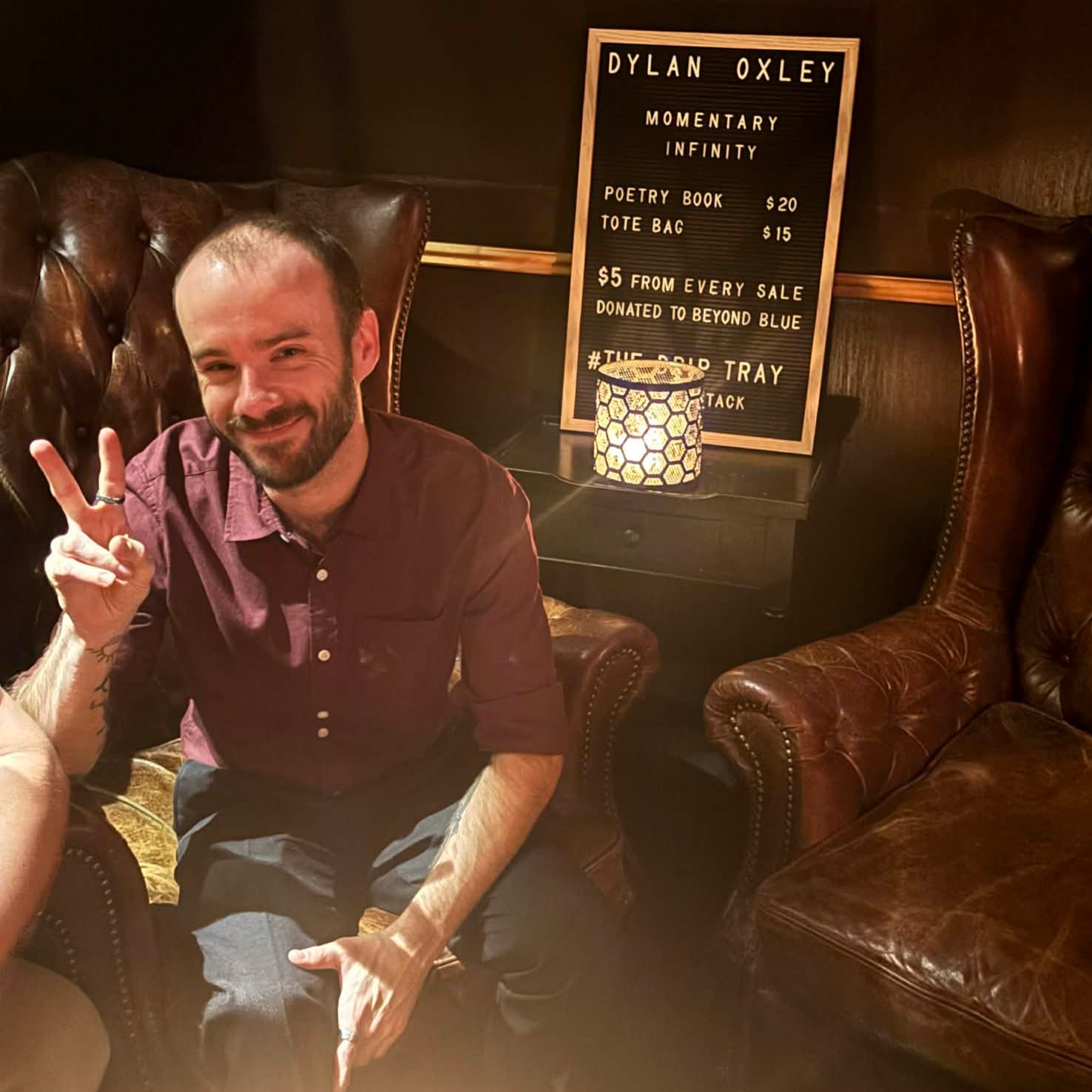
Last Sunday, I celebrated the release with a small group of my favourite people at a whisky bar called Death & Taxes, which was very fitting for the book’s existential themes. From the dim lighting and leather booths to the gothic artwork and film-inspired cocktails, it was me all over. We laughed and ruminated together as I recited poems from the book with personal anecdotes between. I had never hosted nor attended a poetry reading before, so I just winged it, which is pretty much how I’ve approached everything from publishing to marketing. Nonetheless, it was lovely to have these dear friends of mine take the time to ponder life with me and come a little closer together. And isn’t that what poetry is all about?
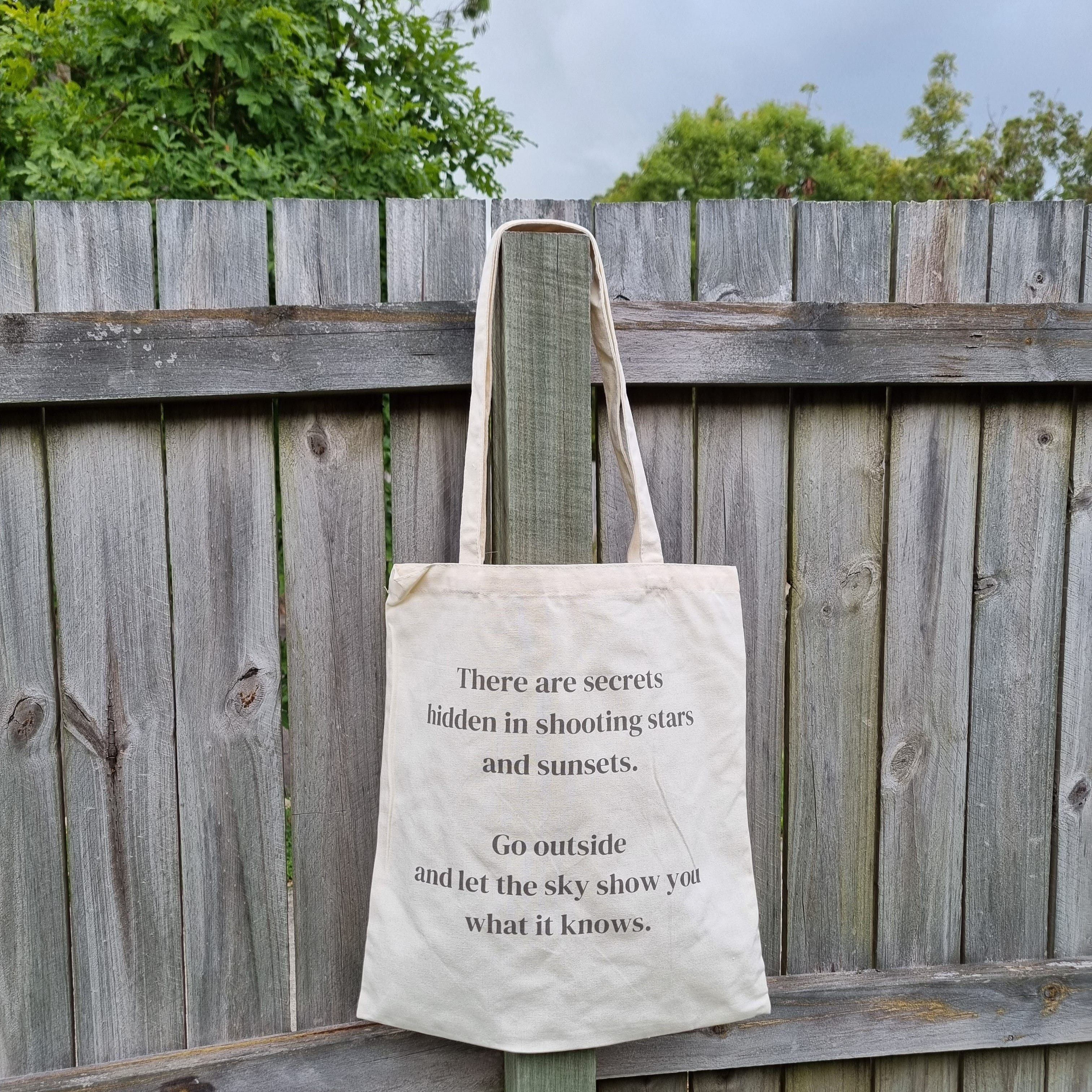
You can buy a copy of Momentary Infinity from my online store HERE and I’ll even write you a nice message inside the cover. The tote bags finally arrived last week, just in time for the reading, so they’re also available to purchase now. These are VERY limited and I won’t be making any more once they sell out, so get in early and rock it like the intellectually sensitive badarse that you are. $5 from every sale will be donated to Beyond Blue, one of Australia’s leading mental health support services, and you can rest easily knowing that you’ve helped an independent artist feel valued. Thank you to those who shared a drink with me on Sunday and everybody who has bought a book or bag. I appreciate you all so much!
I’ll leave you with one of my favourite poems, The Journey from the late Mary Oliver, and I wish you all the best in your own search for yourself.
One day you finally knew
what you had to do, and began,
though the voices around you
kept shouting
their bad advice—
though the whole house
began to tremble
and you felt the old tug
at your ankles.
“Mend my life!”
each voice cried.
But you didn’t stop.
You knew what you had to do,
though the wind pried
with its stiff fingers
at the very foundations,
though their melancholy
was terrible.
It was already late
enough, and a wild night,
and the road full of fallen
branches and stones.
But little by little,
as you left their voices behind,
the stars began to burn
through the sheets of clouds,
and there was a new voice
which you slowly
recognized as your own,
that kept you company
as you strode deeper and deeper
into the world,
determined to do
the only thing you could do—
determined to save
the only life you could save.